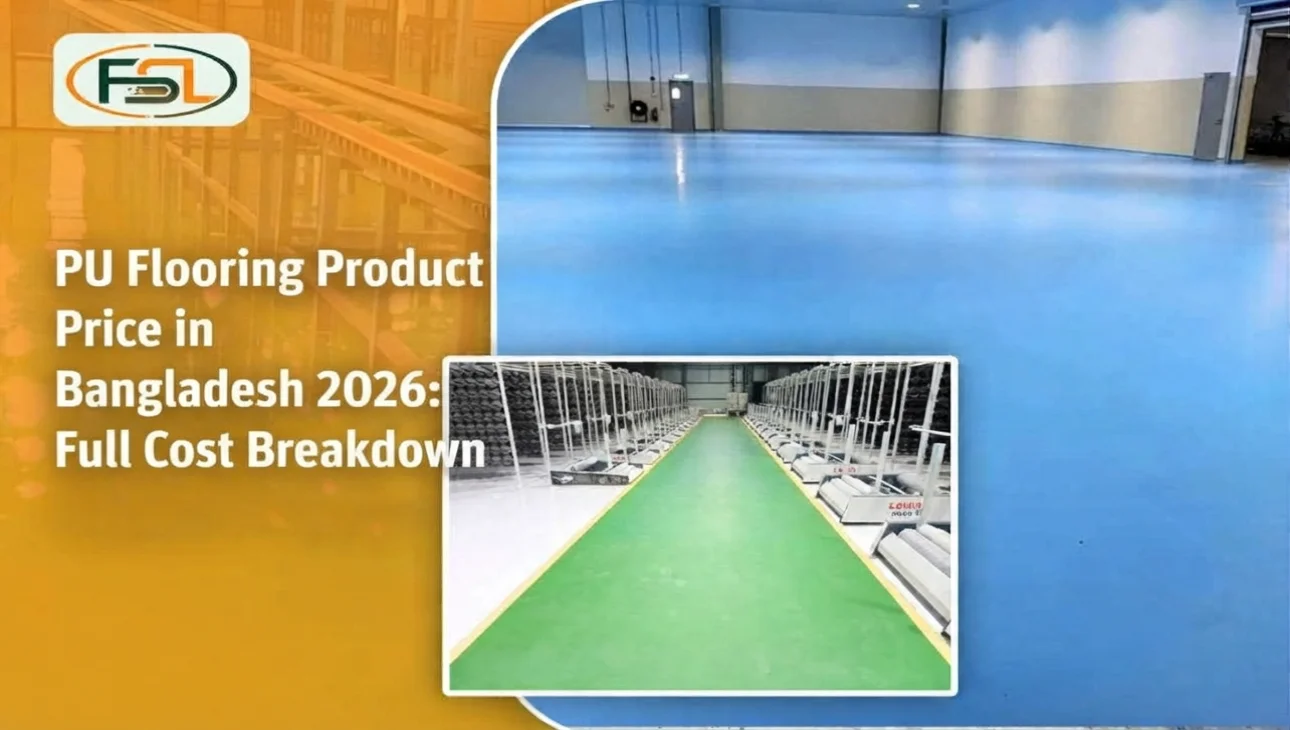
Polyurethane (PU) flooring is rapidly gaining ground in Bangladesh, especially in food and beverage plants, pharmaceutical units, cold rooms, commercial kitchens and breweries. If you are comparing options, the main question is: what is the PU flooring price in Bangladesh in 2026?
PU flooring in Bangladesh generally costs between Tk 90 and Tk 700 per square foot, depending on the system. A thin PU coating is at the low end, PU self-leveling sits around Tk 200 to Tk 350, and heavy-duty PU concrete or screed for wet, hot and cold environments can reach Tk 400 to Tk 700 per square foot.
Let us break down the numbers, so you can plan your budget correctly.
What Is PU Flooring?
PU flooring is a seamless polyurethane resin floor system. Compared with epoxy, it is more flexible, handles thermal shock better and resists a wider range of acids, fats and sugars. It is the preferred solution for hygienic production areas. You can read about our systems on the PU Flooring Solutions page.
PU Flooring Price in Bangladesh 2026 by System
| PU system | Thickness | Estimated price (Tk per sq ft) | Typical use |
| PU floor coating | 0.3 – 0.6 mm | 90 – 160 | Light industrial, UV-exposed areas |
| PU self-leveling | 2 – 3 mm | 200 – 350 | Pharma, labs, showrooms, hospitals |
| PU flexible topcoat on epoxy | 0.3 – 0.5 mm | 120 – 200 | Warehouses needing UV stability |
| PU concrete / screed | 4 – 6 mm | 350 – 550 | Food plants, kitchens, breweries |
| Heavy-duty PU screed | 6 – 9 mm | 450 – 700 | Cold rooms, hot wash-down, dairies |
| Anti-static PU | 2 – 3 mm | 280 – 450 | Electronics, clean rooms |
These ranges are indicative for 2026. For an exact price, an engineer should inspect the substrate, drainage and operating temperature.
What Affects PU Flooring Cost?
1. System thickness
The thicker the PU layer, the greater the resin and aggregate consumption. A 9 mm PU screed for a dairy can cost three times more than a 2 mm self-leveling system.
2. Operating temperature
Cold rooms and hot-wash areas need specially formulated PU concrete. These products are more costly but prevent cracking under thermal shock.
3. Substrate preparation
Like all resin floors, PU needs clean, sound and dry concrete. Grinding, shot blasting, crack repair and moisture barriers are essential. In damp slabs, pair with waterproofing.
4. Drainage and slope work
Food plants require slopes, drain channels, coving and wall-floor junction details. These are priced separately and add to the total.
5. Material brand and origin
Imported PU systems from established manufacturers have higher cost but proven HACCP-ready performance.
6. Project size and access
Large, open production halls offer a better rate than small, scattered rooms. Night shift work may add labour cost.
7. Colour and slip resistance
Broadcast aggregates, anti-slip profiles and specific colours alter the final rate.
PU Flooring vs Epoxy Flooring: Which Is Better for You?
| Feature | PU flooring | Epoxy flooring |
| Price | Higher | Lower |
| Flexibility | High | Rigid |
| Thermal shock | Excellent | Moderate |
| UV stability | Good (no yellowing) | Yellows outdoors |
| Chemical resistance | Very wide (organic acids, fats) | Strong for alkalis and oils |
| Best for | Food, beverage, cold rooms | Factories, car parks, warehouses |
If your floor is a dry industrial area with heavy loads, epoxy is often more economical. See our guide on epoxy flooring price in Bangladesh and our Epoxy Flooring Solutions. For wet, hot or cold production areas, PU is usually the right investment.
Where PU Flooring Is Used in Bangladesh
- Food and beverage plants: Bakeries, biscuit and snack factories, juice and dairy units.
- Pharmaceutical and cosmetic factories: Clean, seamless, easy to sanitize.
- Commercial kitchens and hotels: Resistant to grease, heat and cleaning chemicals.
- Cold storage and freezers: Handles low temperatures without cracking.
- Hospitals and laboratories: Hygienic and chemical resistant.
- Showrooms and offices: Decorative PU self-leveling with a soft underfoot feel.
PU Flooring Installation Process
- Site survey and moisture test
- Grinding or shot blasting of the concrete
- Cutting of chases and edge details
- Repair of cracks and holes
- Primer application
- PU screed or self-leveling layer
- Broadcast or troweling for finish
- Sealer or topcoat
- Curing and handover
The process typically takes 4 to 10 days for a medium-sized area, depending on thickness and drying time.
Hidden Costs to Watch for in a PU Quotation
- Coving and skirting charges
- Drain and channel treatment
- Expansion joint sealing
- Removal of old coatings
- Night work or after-hours surcharge
- Transport to remote sites
Always ask for a line-item quotation that lists thickness in millimetres, brand and warranty period.
How to Save Money on PU Flooring
- Use PU concrete only where truly required, and epoxy in dry areas.
- Plan floor slopes at the construction stage.
- Prepare the slab properly so you avoid costly repairs later.
- Combine multiple areas into one contract.
- Strengthen weak slabs first with a floor hardener.
- Ask for performance warranty rather than the lowest rate.
Maintenance of PU Floors
Routine cleaning with neutral detergent and automatic scrubbers keeps the floor hygienic. Avoid scraping heavy steel directly across the surface. With good care, PU floors can last 10 to 20 years in demanding environments.
Frequently Asked Questions
What is the PU flooring price in Bangladesh per square foot in 2026?
PU coating starts around Tk 90 to Tk 160, self-leveling PU about Tk 200 to Tk 350, and PU concrete about Tk 350 to Tk 700.
Is PU flooring more expensive than epoxy?
Yes, generally by 20 to 60 percent, but it performs better in thermal shock, wet and food-grade environments.
Can PU flooring handle cold rooms and hot washing?
Yes. PU concrete is designed for temperatures ranging from freezer levels to steam cleaning.
How long does PU flooring last?
Normally 10 to 20 years with proper preparation and cleaning.
Is PU flooring slip resistant?
Yes. Aggregate broadcast systems give controlled slip resistance for wet areas.
How soon can the floor be used after installation?
Light traffic after 24 hours and full use after 3 to 5 days depending on thickness.
Get a PU Flooring Quotation from Falcon Solution BD
Falcon Solution BD supplies and installs PU flooring for food factories, pharmaceutical plants, hospitals, kitchens and commercial buildings across Bangladesh. Our engineers recommend the right system for temperature, chemical exposure and budget, and we give a written warranty.
Explore our services: PU Flooring Solutions | Epoxy Flooring Solutions | PU Foam Spray | Water-Proofing
Contact us through falconsolutionbd.com today for a free site visit and a detailed PU flooring estimate.
Read next: Epoxy Flooring Price in Bangladesh 2026 | Vinyl Flooring Price in Bangladesh 2026 | Fair Face Plaster Price in Bangladesh 2026