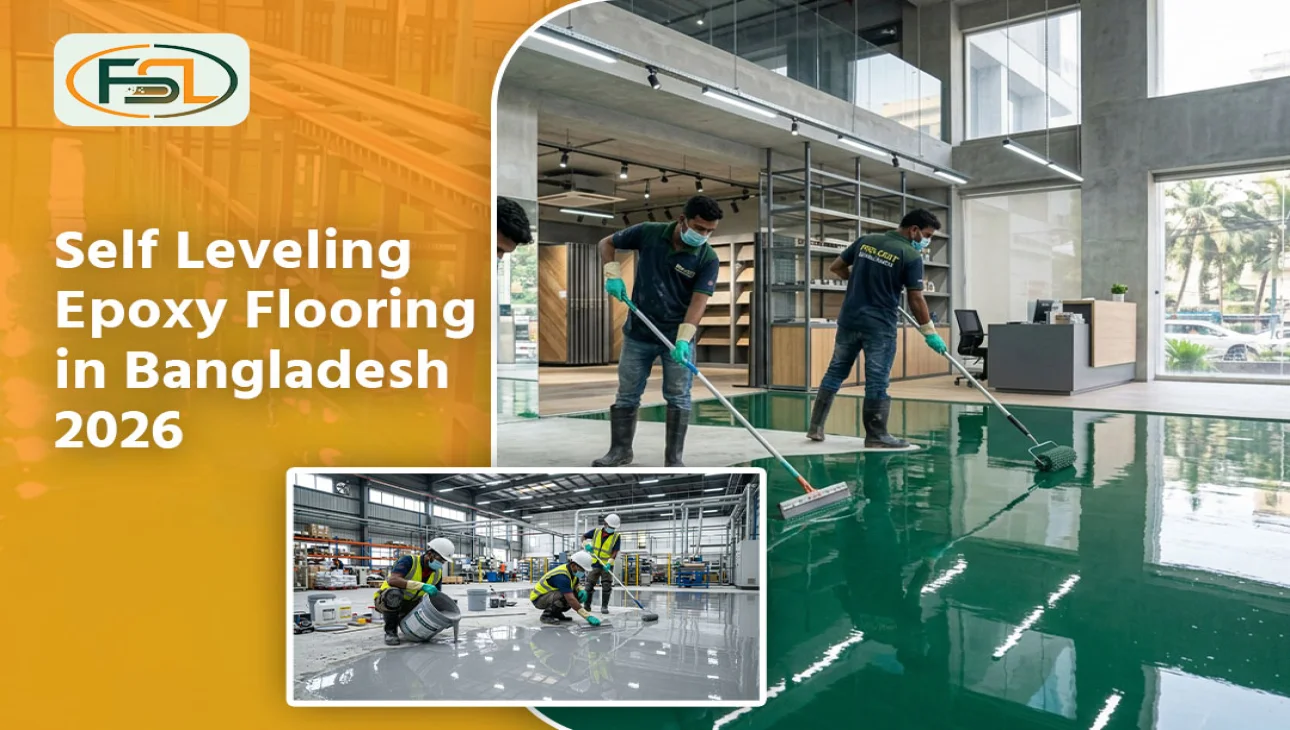
Walk into any modern pharmaceutical plant, food processing unit, or high-end showroom in Bangladesh, and there's a good chance you're standing on self-leveling epoxy flooring without even realizing it. That mirror-smooth, seamless, glossy floor that looks almost like liquid glass isn't an accident — it's a specific flooring system engineered to be perfectly level, extremely durable, and easy to clean.
If you have been researching flooring options for a factory, hospital, commercial space, or even a stylish home, this guide will walk you through everything about self-leveling epoxy flooring in Bangladesh for 2026 — how it works, why it's worth considering, and what it typically costs.
What Is Self-Leveling Epoxy Flooring?
Self-leveling epoxy is a type of resin flooring system that, true to its name, spreads and levels itself out naturally after being poured onto the floor, thanks to its low viscosity. This creates a perfectly flat, smooth, seamless surface, even over concrete that has minor dips, cracks, or unevenness.
Unlike standard epoxy floor paint, which is rolled or brushed on in thin coats, self-leveling epoxy is usually poured and spread with a notched trowel or spiked roller, forming a thicker layer, typically 2mm to 5mm, sometimes more for heavy-duty industrial applications.
Why Self-Leveling Epoxy Is So Popular in Bangladesh
- Hides floor imperfections: Many buildings in Bangladesh, especially older constructions, have concrete floors with small dips, cracks, or unevenness. Self-leveling epoxy fills and smooths these out beautifully, without the need for expensive floor reconstruction.
- Seamless and hygienic: With zero joints or seams, there's nowhere for dust, bacteria, or moisture to collect. This is exactly why pharmaceutical companies, food factories, and hospitals across Bangladesh prefer this system.
- High durability: Because of its thickness and resin density, self-leveling epoxy handles heavy foot traffic, forklifts, trolleys, and industrial equipment far better than thin coatings.
- Excellent chemical and stain resistance: Resistant to oil, grease, mild acids, and most industrial chemicals, making cleanup simple even in messy production environments.
- Attractive, glossy finish: The smooth, reflective surface brightens up interior spaces by bouncing light around, which also helps reduce lighting costs in large warehouses and factories.
- Fast installation: Compared to tiling or other flooring systems, self-leveling epoxy can be installed relatively quickly, minimizing downtime for busy factories and commercial spaces.
Where Is Self-Leveling Epoxy Flooring Used?
- Pharmaceutical and food processing factories (due to hygiene requirements)
- Garment and textile industry floors
- Warehouses and logistics centers
- Hospitals and clean rooms
- Basement and multi-level car parking, especially in combination with anti-slip top coats — see our guide on car parking epoxy flooring
- Showrooms, corporate offices, and retail spaces
- High-end residential floors and rooftops
The Installation Process
A properly installed self-leveling epoxy floor goes through several careful stages:
- Site and moisture assessment — checking for dampness, since trapped moisture under epoxy causes bubbling and delamination
- Surface preparation — usually diamond grinding or shot blasting to remove laitance, old coatings, and open the concrete pores for better bonding
- Crack and joint repair — filling structural cracks and low spots before the main application
- Primer coat — sealing the concrete and improving adhesion of the epoxy layer
- Self-leveling epoxy pour — mixed resin is poured and spread using a notched trowel, then rolled with a spiked roller to release trapped air bubbles
- Top coat (optional) — for extra gloss, UV resistance, or anti-slip texture depending on the application
- Curing period — usually 24 to 72 hours before light foot traffic, and up to 7 days for full chemical and mechanical resistance
The whole process, depending on area size and floor condition, typically takes anywhere from 3 to 10 days.
Self-Leveling Epoxy Flooring Price in Bangladesh (2026)
Because self-leveling epoxy requires more material thickness and skilled application than basic epoxy paint, it generally costs more per square foot. Based on current 2026 market trends across Bangladesh:
| Self-Leveling Epoxy Flooring Type | Thickness | Estimated Price (BDT/Sq. Ft.) | Best For |
| Standard Self-Leveling Epoxy | 2–3 mm | ৳180 – ৳350 | Showrooms, hospitals, laboratories, commercial buildings |
| Industrial-Grade Self-Leveling Epoxy | 3–5 mm | ৳300 – ৳500 | Factories, warehouses, pharmaceutical plants, heavy-duty industrial areas |
| Decorative / Metallic Self-Leveling Epoxy | 2–5 mm | ৳400 – ৳800+ | Luxury homes, retail stores, hotels, offices, premium commercial spaces |
Note: Final cost depending on floor condition, project size, surface preparation, material brand, application thickness, and site location.
Factors that influence the final price include:
- Existing floor condition and required surface preparation
- Required thickness based on expected traffic load
- Total project area (larger jobs often get better per-square-foot rates)
- Special requirements like anti-slip additives, chemical resistance grade, or decorative finishes
- Whether the project is indoor (controlled environment) or requires additional UV protection
As always, a physical site inspection is the only reliable way to get an exact quotation, since floor condition varies a lot between buildings.
Self-Leveling Epoxy vs Standard Epoxy Coating — What's the Difference?
Many people confuse the two, so here's a simple breakdown:
| Feature | Standard Epoxy Coating | Self-Leveling Epoxy |
| Thickness | Thin (0.3mm–1mm) | Thick (2mm–6mm) |
| Application | Rolled or brushed | Poured and trowel-spread |
| Best for | Light to medium traffic | Heavy industrial and commercial traffic |
| Hides floor imperfections | Limited | Excellent |
| Price | Lower | Moderate to higher |
| Lifespan | 5–8 years | 10–15+ years with proper maintenance |
If your floor has visible unevenness, cracks, or you need a truly heavy-duty industrial surface, self-leveling epoxy is almost always the smarter long-term investment.
Maintenance Tips for a Long-Lasting Floor
- Sweep or dust-mop regularly to prevent grit from scratching the glossy surface
- Use a mild detergent for mopping — avoid harsh acidic or abrasive cleaners
- Address any oil or chemical spills quickly, even though the surface resists staining
- Avoid dragging heavy metal equipment directly across the floor without protective padding
- Schedule a professional inspection every couple of years for high-traffic industrial floors
Common Mistakes to Avoid
- Skipping moisture testing: This is the number one cause of epoxy failure in Bangladesh's humid climate, especially in ground-floor and basement installations.
- Rushing curing time: Allowing vehicle or heavy equipment traffic before the epoxy fully cures weakens the final bond.
- Choosing thickness based on price alone: A thinner system might look similar on day one but won't hold up under real industrial use.
- Hiring inexperienced applicators: Self-leveling epoxy requires precise mixing ratios and quick, skilled application before the material starts to set.
Why Work With a Specialist Flooring Company
Self-leveling epoxy is technically more demanding than basic epoxy paint. It requires experienced applicators who understand mixing ratios, working time, and environmental conditions like humidity and temperature — all of which affect how the epoxy cures. A specialist company will also properly assess your floor's structural condition first, rather than just applying epoxy over existing problems.
Why Hygiene-Focused Industries Prefer Self-Leveling Epoxy
Bangladesh's pharmaceutical and food processing sectors have grown rapidly, and with that growth comes stricter hygiene and quality certification requirements, often tied to export markets in the EU, USA, and Middle East. Self-leveling epoxy flooring plays a direct role in meeting these standards because:
- It creates a completely seamless surface with no grout lines or joints where bacteria, mold, or moisture could collect
- It resists a wide range of cleaning chemicals used in sterile production environments without degrading
- It can be formulated to meet specific hygiene certifications required for GMP (Good Manufacturing Practice) facilities
- Its smooth, non-porous surface makes routine sanitation faster and more effective, which matters a lot in facilities running multiple daily cleaning cycles
For garment factories, self-leveling epoxy also plays a slightly different role — protecting the floor from constant trolley movement, fabric dust, and machine oil while keeping the production floor bright and easy to keep clean for quality control purposes.
Choosing the Right Thickness for Your Facility
One question we get asked constantly is "how thick should my self-leveling epoxy floor actually be?" Here's a simple general guide:
- 2mm: Suitable for light commercial use, offices, and showrooms with foot traffic only
- 3mm: A solid middle-ground choice for most commercial and light industrial applications
- 4–5mm: Recommended for warehouses, factories, and spaces with regular trolley or light machinery movement
- 6mm and above: Reserved for heavy industrial environments with constant forklift traffic, dropped tools, or very heavy static loads
Choosing a thickness that matches your actual traffic conditions, rather than just picking the cheapest option, is one of the smartest ways to avoid premature floor failure and costly redo work down the line.
Frequently Asked Questions
How long does self-leveling epoxy flooring last?
With proper installation and reasonable maintenance, self-leveling epoxy typically lasts 10 to 15+ years, even in busy industrial environments.
Can self-leveling epoxy be installed over old, cracked concrete?
Yes, and this is actually one of its biggest advantages. As long as structural cracks are properly repaired first, self-leveling epoxy can smooth over minor surface imperfections beautifully.
Is self-leveling epoxy slippery?
The standard glossy finish can be slippery when wet, so anti-slip additives or a textured top coat are recommended for areas prone to spills or moisture, including parking structures and food processing floors.
How long before the floor can be used after installation?
Light foot traffic is usually possible within 24 to 72 hours, while full chemical and mechanical resistance typically develops within about a week.
Is self-leveling epoxy more expensive than regular epoxy paint?
Yes, generally. Because it requires more material thickness and more skilled application, self-leveling epoxy typically costs somewhat more per square foot than thin, rolled epoxy coatings, but it also lasts considerably longer and performs better under heavy use.
Can self-leveling epoxy be used outdoors?
It can, but outdoor applications need a UV-stable top coat, often polyurethane-based, to prevent yellowing and surface degradation from direct sunlight over time.
Falcon Solution Ltd — Self-Leveling Epoxy Flooring Experts in Bangladesh
At Falcon Solution Ltd, self-leveling epoxy flooring is one of our core specialties. With almost a decade of experience and over 1,500 completed projects across Bangladesh, our trained technicians handle every stage — from moisture testing and surface preparation to the final glossy pour — using premium resin systems sourced from trusted international suppliers.
Explore more of our flooring solutions:
- Self Leveling Epoxy Flooring
- Epoxy Flooring Solutions in Bangladesh
- Epoxy Car Parking Solutions
- PU Flooring Solutions
Planning a self-leveling epoxy floor for your factory, warehouse, or commercial space? Call us at +88 01329 74 22 00 / +880 1744-798865, email info@falconsolutionbd.com, or get a free quotation here. Our team will visit your site and recommend the right system for your exact needs and budget.