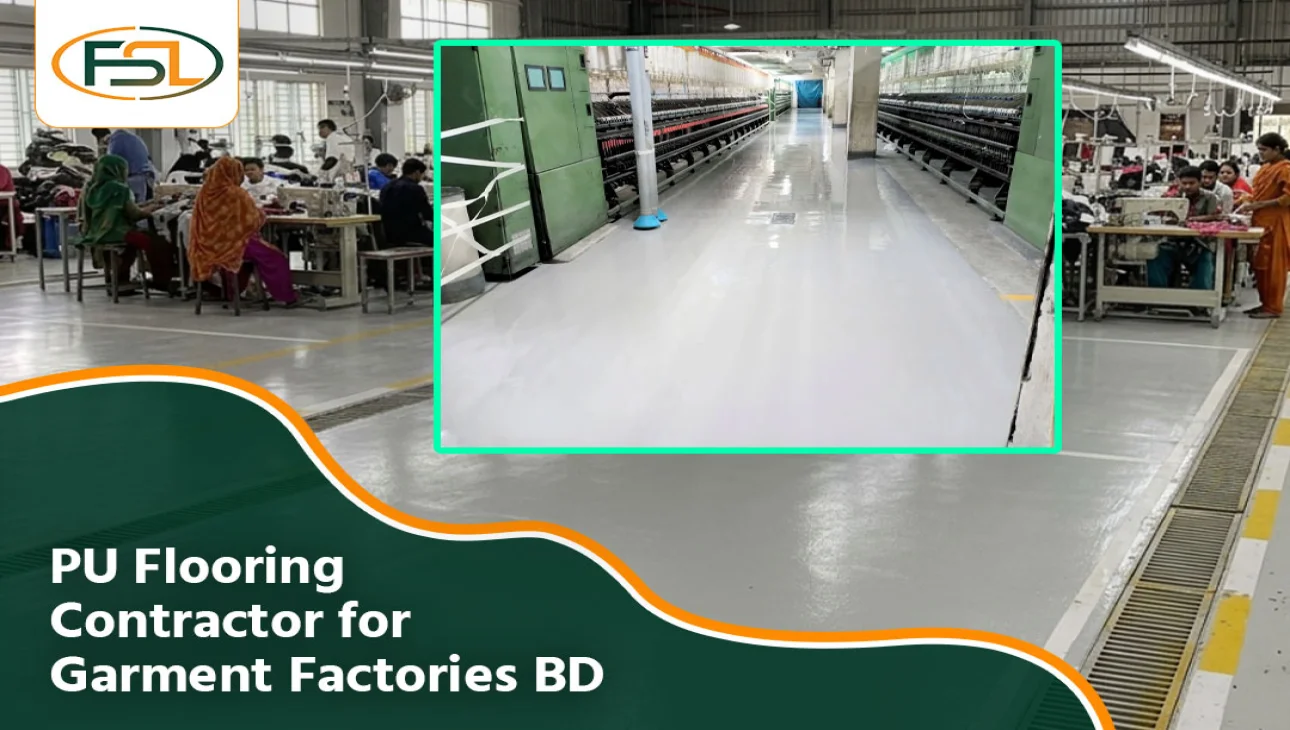
Bangladesh's ready-made garment (RMG) sector runs on speed, cleanliness, and compliance — and the factory floor is where all three either succeed or fail. A cracked, dusty, or slippery concrete floor slows down cutting and sewing lines, creates safety hazards, and can even threaten buyer compliance audits (BSCI, Accord/Alliance follow-up bodies, Sedex). This is exactly why more RMG owners in Dhaka, Gazipur, Savar, Ashulia, and Narayanganj are hiring a specialized epoxy flooring contractor for garment factories in Bangladesh instead of relying on tiles, mosaic, or plain concrete.
This guide breaks down why epoxy flooring has become the industry standard for garment factories, what it costs, how it's installed without stopping production, and how to choose the right flooring contractor.
Why Garment Factories in Bangladesh Are Switching to Epoxy Flooring
Traditional concrete floors in RMG factories shed dust and fine particles that contaminate fabric, clog machinery, and create respiratory hazards on the sewing floor. Tiles crack under constant trolley and cart movement and their grout lines trap lint, thread waste, and bacteria. Epoxy flooring solves all of this with a single, seamless, resin-based coating that bonds directly to the concrete substrate.
Key reasons garment factories prefer epoxy flooring:
- Dust-free, lint-free surface — seals porous concrete so fine dust can't rise into the air or settle on fabric
- Seamless, joint-free finish — no grout lines for thread waste, lint, or bacteria to collect in
- High load-bearing strength — withstands trolley carts, fabric rolls, cutting tables, and heavy sewing machine banks
- Chemical and oil resistance — protects against dye spills, machine oil, and cleaning agents in washing/dyeing sections
- Anti-static (ESD) options — critical for sections with sensitive electronics, embroidery machines, and automated cutters
- Fast cure time — minimizes production downtime during installation
- Compliance-friendly — supports buyer audit requirements (BSCI, Sedex, WRAP) around workplace hygiene and safety
Where Epoxy Flooring Is Used Inside a Garment Factory
Every section of an RMG factory has different flooring stress points, so a proper contractor will recommend a system per zone rather than a one-size-fits-all coating.
| Factory Section | Recommended Flooring | Why |
| Cutting section | High-build epoxy / anti-static epoxy | Reduces fabric dust, protects against static discharge near automated cutters |
| Sewing floor | Self-leveling epoxy | Even, seamless surface for smooth trolley movement between lines |
| Finishing & packing | Standard industrial epoxy | Handles cartons, pallet trucks, and constant foot traffic |
| Dyeing / washing section | Chemical-resistant epoxy | Resists dye, bleach, and acid exposure |
| Generator & boiler room | Oil and heat-resistant epoxy | Withstands fuel spills and elevated surface temperature |
| Warehouse / fabric store | Heavy-duty floor hardener or epoxy | Supports forklift and heavy roll storage traffic |
Epoxy Flooring Cost for Garment Factories in Bangladesh
Pricing depends on floor condition, coating thickness, and whether the section needs anti-static or chemical-resistant grade epoxy. Broadly, costs vary by:
- Floor preparation needs — grinding, crack repair, and moisture level of the existing concrete
- Coating system — standard epoxy vs. self-leveling vs. anti-static (ESD) epoxy
- Thickness — thin-film coatings vs. high-build systems for heavy-traffic zones
- Total area — larger contiguous areas typically bring the per-sq.ft. rate down
Because every factory floor is different, Falcon Solution Ltd. provides a free on-site assessment and written quotation before any work begins — no obligation, no hidden costs.
The Installation Process (Without Stopping Production)
A specialized garment-factory flooring contractor plans installation in phases so lines can keep running:
- Site survey & moisture testing — assess the concrete slab and identify problem zones
- Surface preparation — diamond grinding to remove laitance and open the concrete pores for adhesion
- Crack and spall repair — structural epoxy mortar fills damaged areas
- Primer application — penetrating epoxy primer seals moisture and bonds to the substrate
- Self-leveling / top coat — the final high-build or anti-static layer is applied section by section, often scheduled during off-shifts or weekends
- Curing & quality inspection — thickness, gloss, and adhesion are checked before handover
How to Choose the Right Epoxy Flooring Contractor
When evaluating contractors for a garment factory project, ask:
- Do they have documented experience with RMG factories specifically, not just generic industrial flooring?
- Can they supply ISO or TÜV NORD certification and material data sheets for imported resins?
- Do they offer anti-static/ESD flooring for sensitive sections?
- Can they phase installation to avoid production shutdowns?
- Do they provide a written warranty and after-sales maintenance support?
Falcon Solution Ltd. is an ISO & TÜV NORD certified flooring company with 9+ years of experience and 1500+ completed projects across Bangladesh's industrial sector, including multiple garment and textile factories in Gazipur and Savar. Our teams have resurfaced cracked, dust-shedding cutting-floor concrete with slip-resistant, seamless systems built specifically for RMG production environments.
Frequently Asked Questions
Is epoxy flooring suitable for a garment factory's sewing floor?
Yes. Self-leveling epoxy creates a smooth, seamless surface that supports trolley and cart movement between sewing lines while remaining easy to clean.
How long does epoxy flooring last in a garment factory?
With proper installation and normal industrial use, a correctly specified epoxy floor typically lasts 8–10+ years before recoating is needed.
Can epoxy flooring be installed without stopping factory operations?
Yes. Experienced contractors phase the work section by section, often during off-shifts, so production is not fully interrupted.
Does epoxy flooring help with BSCI or buyer compliance audits?
A clean, dust-free, hazard-free floor supports workplace safety and hygiene expectations commonly assessed in social compliance audits, though flooring is just one component of overall compliance.
What is anti-static epoxy flooring and does my factory need it?
Anti-static (ESD) epoxy dissipates static electricity and is recommended for sections with automated cutting machines, embroidery units, or sensitive electronic equipment.
Get a Free Epoxy Flooring Assessment for Your Garment Factory
Falcon Solution Ltd. has been Bangladesh's trusted flooring and construction chemical partner for over 9 years, delivering seamless, durable, and compliance-friendly epoxy flooring to garment and textile factories across Dhaka, Gazipur, Savar, Ashulia, Narayanganj, and Chattogram.
Talk to our flooring engineer today — same-day response, no obligation.
📞 Call: +88 01329 74 22 00 💬 WhatsApp: +880 1744-798865 📧 Email: falconsolution18@gmail.com 🌐 Get a free quote: Request Your Free Floor Assessment
Explore Our Related Services
- Epoxy Flooring Solutions in Bangladesh
- Self Leveling Epoxy Flooring
- PU Flooring Solutions
- Floor Hardener
- Epoxy Wall Coating and Paint
- ETP Protective Coating
Related Reading on Our Blog
- Epoxy Flooring: ইন্ডাস্ট্রিয়াল ফ্লোরের পাওয়ারহাউস
- Types of PU Flooring: Finding the Right System for Your Industrial Space
- PU Flooring বনাম Epoxy Flooring: কোনটি আপনার প্রজেক্টের জন্য উপযুক্ত?