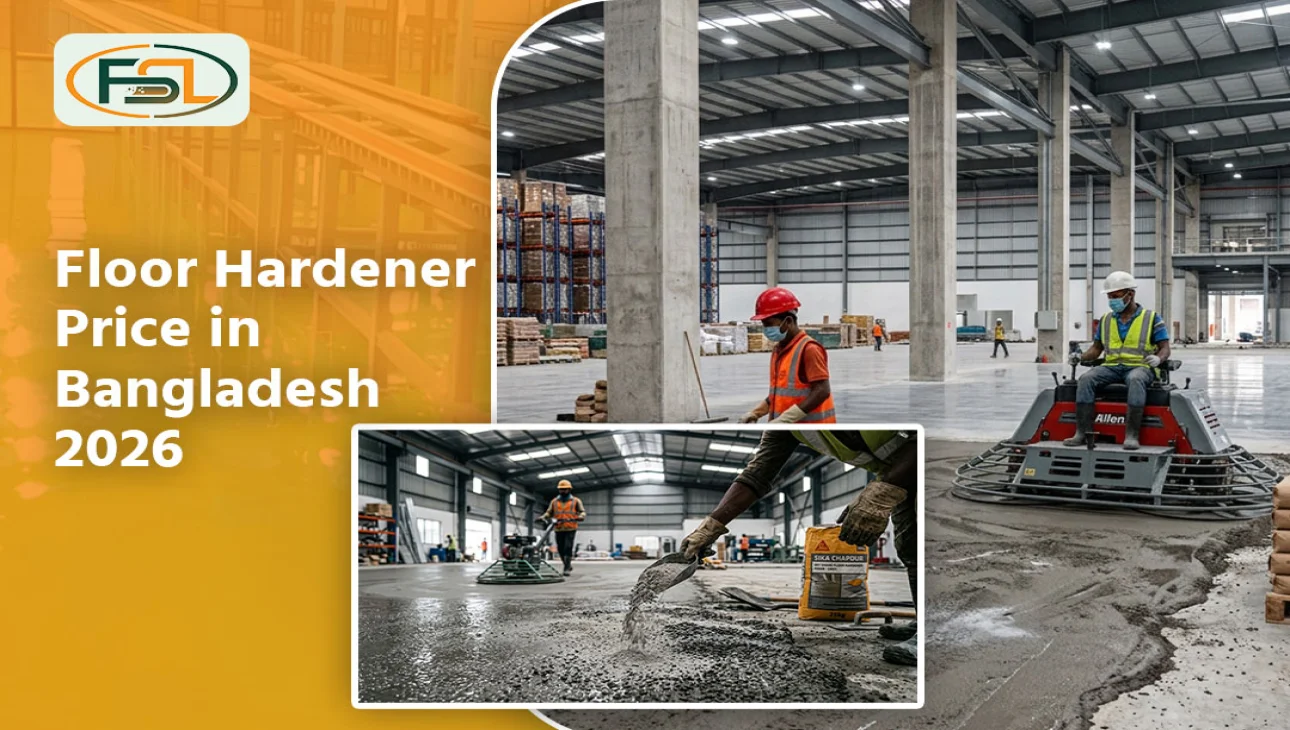
If you manage a warehouse, factory floor, or any high-traffic industrial space in Bangladesh, you have probably noticed how quickly plain concrete wears down. Constant forklift movement, heavy pallets, dragging equipment, and daily foot traffic slowly grind away at the surface, releasing fine dust and eventually creating an uneven, unsafe floor.
Floor hardener is one of the most cost-effective solutions to this exact problem, and it's why so many factories across Bangladesh use it as either a standalone system or as a base layer before applying epoxy or PU coatings. Let's walk through what floor hardener actually is, how it's priced in 2026, and where it makes the most sense for your facility.
What Is Floor Hardener?
Floor hardener is a dry-shake or liquid-applied material — typically made from cement, quartz aggregate, metallic particles, or specialized hardening compounds — that gets applied to freshly poured concrete or an existing slab to significantly increase its surface strength, abrasion resistance, and durability.
There are three main types available in Bangladesh:
Non-metallic floor hardener: Made with quartz or other mineral aggregates, ideal for general industrial and commercial use. Cost-effective and widely used.
Metallic floor hardener: Contains fine metallic particles (often iron-based) for maximum abrasion resistance, typically used in extremely heavy-traffic areas like factories with constant forklift and machinery movement.
Polymer-modified floor hardener: Combines cement-based hardener with polymer additives for improved bonding and slightly better chemical resistance.
Why Floor Hardener Matters for Industrial Floors
Increased surface strength: Floor hardener significantly boosts the compressive and abrasion resistance of concrete, often doubling or tripling its resistance to wear compared to plain concrete.
Dust reduction: Untreated concrete releases dust particles over time due to surface erosion. Floor hardener seals and strengthens the surface, dramatically reducing this dusting effect — a big deal for facilities near sensitive equipment or products.
Cost-effective protection: Compared to epoxy or PU flooring systems, floor hardener is one of the more budget-friendly ways to extend a concrete floor's lifespan.
Improved appearance: A properly applied floor hardener gives concrete a smoother, more polished look compared to raw, untreated concrete.
Foundation for other systems: Floor hardener is often used as a preparatory layer before applying epoxy flooring or self-leveling epoxy flooring on top, giving the final system a stronger, more stable base.
Floor Hardener Price in Bangladesh 2026
Based on current market trends across Bangladesh's construction chemical suppliers, here is a general breakdown for 2026:
| Floor Hardener Type | Price Range (per sq. ft.) |
| Non-metallic floor hardener | BDT 15 – 40 |
| Metallic floor hardener | BDT 25 – 55 |
| Polymer-modified floor hardener | BDT 30 – 60 |
| Combined with epoxy/PU top coat system | BDT 100 – 300+ |
Note: Final cost depending on floor condition, project size, surface preparation, material brand, application thickness, and site location.
Material alone (sold by weight, in 20–25kg bags or buckets) typically ranges from around BDT 900 to 7,000 per bag depending on brand and formulation, but pricing per square foot (which includes application labor and coverage rate) is the more practical way to budget for a full project.
What Affects Floor Hardener Pricing?
1. Type of hardener: Metallic and polymer-modified variants cost more than standard non-metallic options due to their raw material composition.
2. Application method: Dry-shake application (sprinkled onto fresh, still-wet concrete and then floated smooth) is typically used during new construction, while liquid-applied hardeners work on existing, cured concrete floors.
3. Coverage thickness: Heavier application rates for extremely high-traffic areas increase material usage and therefore cost.
4. Surface condition: Existing floors that need grinding, cleaning, or crack repair before hardener application will cost more than fresh concrete pours.
5. Project size: Larger industrial facilities typically achieve better per-square-foot pricing due to bulk material purchasing and efficient labor allocation.
6. Brand and quality: Established, tested brands with proven long-term performance (often lasting 10 to 25 years) may cost more upfront than unbranded alternatives, but usually offer better value over time.
Dry-Shake vs Liquid Floor Hardener — Which One Do You Need?
Dry-shake floor hardener is applied during the concrete pouring stage — sprinkled onto the fresh concrete surface and then power-floated in. This method integrates the hardener directly into the top layer of the slab, offering maximum bonding and the longest-lasting protection. It is the preferred choice for new construction projects like factories and warehouses being built from scratch.
Liquid floor hardener (often silicate or siliconate-based) is applied to already-cured concrete floors. It penetrates the surface and chemically reacts with the concrete to densify and strengthen it. This is the go-to option for existing buildings that didn't originally use a dry-shake hardener but now need better durability and dust control.
Where Floor Hardener Is Commonly Used in Bangladesh
- Garment and textile factories
- Warehouses and logistics/distribution centers
- Manufacturing plants
- Parking garages and loading docks, often as a base layer before epoxy car parking flooring
- Cold storage facility floors
- Any high-traffic commercial or industrial space needing a durable, dust-free surface on a budget
Floor Hardener vs Epoxy Flooring — Which Is More Cost-Effective?
This depends entirely on your facility's needs:
- If your priority is basic durability and dust control at the lowest possible cost, floor hardener alone is a smart, budget-friendly choice.
- If you need chemical resistance, a glossy or decorative finish, or complete waterproofing of the surface, epoxy or PU flooring is the better (though more expensive) option.
- Many facilities in Bangladesh actually combine both — applying floor hardener first for structural strength, then adding an epoxy or PU top coat for chemical resistance, hygiene, and appearance.
Installation Process
- Surface preparation — cleaning and, if needed, grinding the existing floor
- Application — either dry-shake during fresh concrete pouring, or liquid application on cured concrete
- Floating and finishing — for dry-shake systems, power floating integrates the hardener into the surface
- Curing — allowing the treated floor to properly cure before heavy traffic resumes, typically several days depending on the system used
How to Get an Accurate Quote
Floor hardener pricing depends on your specific facility type, expected traffic load, and current floor condition. A reliable contractor will:
- Inspect your existing floor or discuss your new construction plans
- Recommend the right hardener type based on your traffic and durability needs
- Provide a clear, itemized quotation covering material and labor
- Advise honestly on whether a standalone hardener or a combined hardener-plus-coating system makes more sense for your budget
Signs Your Floor Needs a Hardener Treatment
Even if your building already has a poured concrete floor, it might benefit from a floor hardener application if you notice:
- Fine dust appearing on the floor surface, especially near forklift paths or high-traffic zones
- Visible surface wear, small pits, or a rough, aging texture on the concrete
- Difficulty keeping the floor clean despite regular sweeping and mopping
- Plans to increase traffic load, such as adding heavier machinery or more frequent forklift movement
- Preparing the floor as a base layer before installing epoxy or PU coatings on top
Floor Hardener and Bangladesh's Industrial Growth
As Bangladesh's manufacturing sector, particularly garments, pharmaceuticals, and light engineering, continues to expand, more factories are being built or renovated with an eye toward long-term floor durability rather than just meeting minimum construction standards. Floor hardener plays a quiet but important role here, since factory floors that dust excessively or wear down quickly can actually affect product quality in sensitive manufacturing environments, slow down equipment movement, and increase long-term maintenance costs. Many factory owners we work with treat floor hardener application as a standard part of new construction, rather than an optional upgrade, simply because the cost difference compared to plain concrete is relatively small while the durability benefit is substantial.
Common Mistakes When Applying Floor Hardener
- Incorrect timing for dry-shake application: Dry-shake floor hardener must be applied at precisely the right stage of concrete curing — too early and it sinks unevenly, too late and it fails to bond properly.
- Insufficient floating and finishing: Proper power-floating is essential to integrate the hardener evenly into the concrete surface; rushed finishing leads to patchy strength and appearance.
- Skipping surface preparation on existing floors: For liquid-applied hardener on older concrete, skipping proper cleaning and degreasing significantly reduces how well the product penetrates and bonds.
- Choosing the wrong hardener type for the application: Metallic hardeners, for example, aren't ideal for wet or corrosive environments, where non-metallic or polymer-modified options perform better.
Frequently Asked Questions
How long does floor hardener last? With proper application, floor hardener typically lasts 10 to 25 years, depending on the type used and the traffic load it experiences.
Can floor hardener be applied to an old concrete floor? Yes, using a liquid-applied floor hardener, which chemically penetrates and densifies existing cured concrete. Dry-shake hardener, on the other hand, can only be applied during the initial concrete pour.
Is floor hardener the same as epoxy flooring? No. Floor hardener strengthens and densifies the concrete surface itself, while epoxy flooring adds a separate resin coating on top. Many facilities use both together for maximum durability and a polished finish.
Does floor hardener eliminate concrete dust completely? It significantly reduces dusting by strengthening the surface, though for a completely dust-free, glossy finish, many facilities add an epoxy or PU top coat over the hardened surface.
Is metallic or non-metallic floor hardener better? Metallic hardener offers slightly higher abrasion resistance and is often used in the heaviest-traffic industrial zones, while non-metallic hardener is more versatile, cost-effective, and suitable for most general industrial and commercial applications, including wetter environments where metallic particles could be a concern.
How soon can a floor be used after hardener application? This depends on the concrete curing schedule for dry-shake systems, typically several days, while liquid-applied hardener on existing floors usually allows normal use within 24 to 48 hours after application.
Falcon Solution Ltd — Floor Hardener Solutions in Bangladesh
Falcon Solution Ltd provides reliable, durable floor hardener solutions for factories, warehouses, and commercial spaces across Bangladesh, backed by nearly a decade of experience and over 1,500 completed projects. Whether you need a standalone hardener application or a combined system with epoxy or PU top coats, our team will recommend the most practical, cost-effective solution for your facility.
Explore our related services:
Want to strengthen and protect your industrial floor without overspending? Call us at +88 01329 74 22 00 / +880 1744-798865, email info@falconsolutionbd.com, or request a free consultation here. Our engineers will assess your facility and recommend the right floor hardener solution for your traffic load and budget.